23 Nov 2026
Navigating the November 30, 2026 AI API Retirements: A Migration Guide for Data Scientists & ML Engineers
By Diwakar Chandra Gour
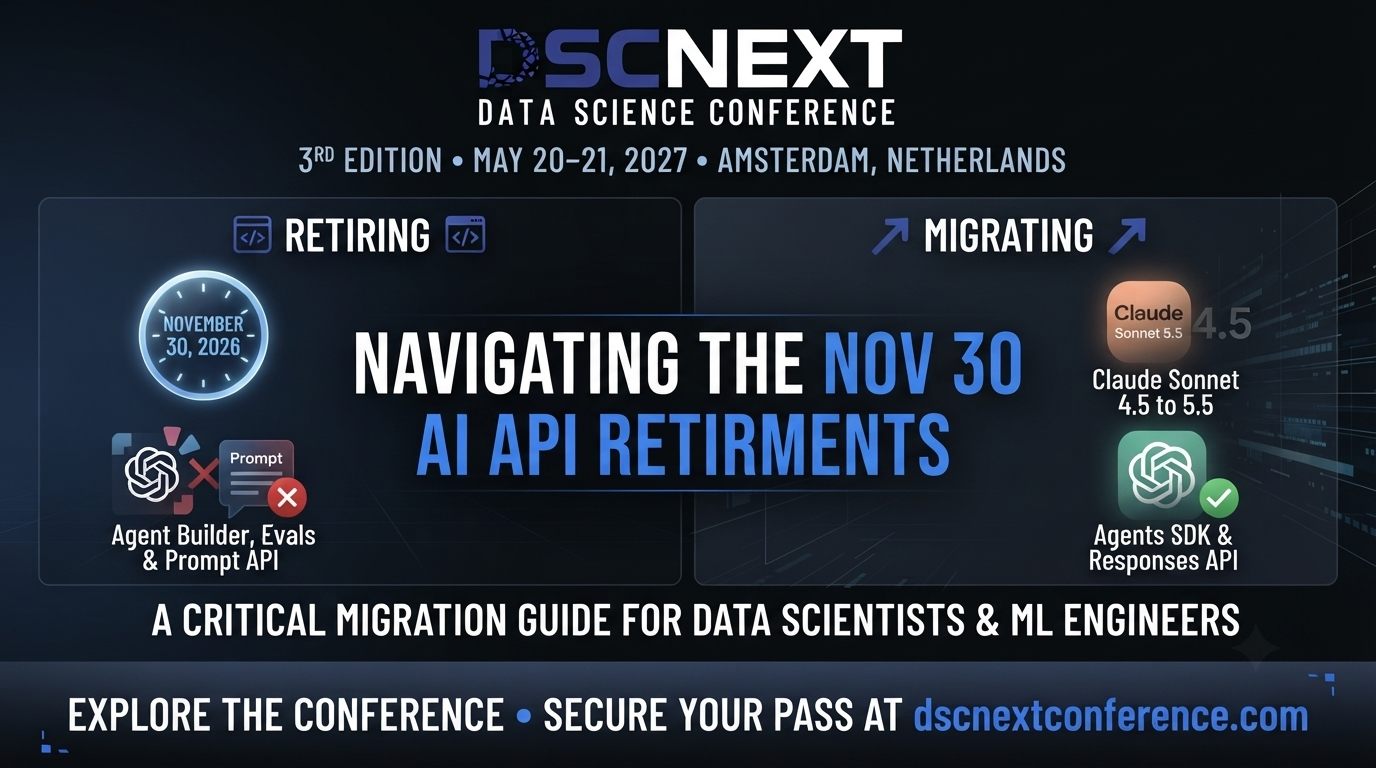
Navigating the November 30, 2026 AI API Retirements: A Migration Guide for Data Scientists & ML Engineers
As generative AI and agentic workflows become core infrastructure across enterprise data pipelines, managing platform lifecycles is no longer optional—it is a mission-critical engineering discipline. With November 30, 2026, fast approaching, data scientists, machine learning engineers, and AI developers face a major convergence of platform deprecations from both OpenAI and Anthropic.
On this cutoff date, OpenAI is permanently shutting down its legacy Agent Builder, the hosted Evals API and dashboard, and the v1/prompts API (reusable prompt objects). Simultaneously, Anthropic is retiring its Claude Sonnet 4.5 API (claude-sonnet-4-5-20250929 and the undated claude-sonnet-4-5 alias). Any production pipeline, CI/CD evaluation gate, or customer-facing agent still pointing to these endpoints after November 30 will immediately return errors.
Breaking Down the OpenAI Deprecations
First announced on June 3, 2026, OpenAI’s November 30 shutdown consolidates its developer tooling around code-first architectures and the Responses API. Teams must address three distinct breaking changes:
Agent Builder Shutdown: Visual workflows created in OpenAI's Agent Builder will stop executing on November 30. While front-end interfaces built with ChatKit remain available, any ChatKit deployment backed by an Agent Builder workflow ID will lose its hosted backend. OpenAI’s official migration path directs teams to rebuild agent logic using the Agents SDK, ChatGPT Workspace Agents, or custom wrappers built directly over the Responses API.
Evals API & Dashboard Retirement: Existing evaluations already transitioned to read-only mode on October 31, 2026. On November 30, both the dashboard and the
/evalsAPI—including hosted graders and the dataset-backed prompt optimizer—go offline. If your CI/CD pipelines rely on the Evals API to gate model releases, those checks will fail. OpenAI points developers to open-source frameworks like Promptfoo to recreate evaluation suites.v1/promptsAPI & Reusable Prompt Objects: Hardcoded references to stored prompt object IDs will break once thev1/promptsendpoint shuts down. Developers must extract stored prompt templates and move the prompt content directly into application code, configuration files, or internal version-controlled registries.
Transitioning Off Anthropic’s Claude Sonnet 4.5
Following its 60-day deprecation notice issued on September 30, 2026, Anthropic is retiring Claude Sonnet 4.5 on November 30. After the deadline, all API calls targeting claude-sonnet-4-5-20250929 (or claude-sonnet-4-5) will fail.
Anthropic’s recommended replacement is Claude Sonnet 5.5 (claude-sonnet-5-5). However, ML engineers should treat this as an architectural update rather than a simple model-string swap:
Stricter Parameter Validation: Sonnet 5.5 enforces updated request constraints—passing non-default
temperaturesampling parameters or assistant message prefills will trigger400errors if not removed from your API wrapper. Additionally, setting thinking todisabledreturns a400error on Sonnet 5.5, requiring teams to use the lowest supported thinking configuration instead.Response Block Parsing: Because newer Claude models can emit structured thinking blocks at the start of a response, rigid parsers that assume the final text sits at
contentwill break unless updated to filter response blocks by type.Token & Cost Calibration: Tokenization density differs significantly—identical text produces roughly 30% more tokens on Sonnet 5.5—requiring teams to re-benchmark latency, context budgets, and token spend before cutting over production traffic.
Building Future-Proof AI Pipelines
The November 30 retirements—alongside additional OpenAI model sunsets scheduled for December 1, December 11, 2026 (including GPT-5 and o3 variants), and January 14, 2027—highlight a broader reality in modern data science: foundation models and hosted orchestration tools evolve far faster than traditional software dependencies.
By abstracting LLM calls behind clean adapter layers, storing prompts alongside application code, and adopting portable, open-source evaluation frameworks, data science teams can turn vendor deprecations from emergency fire drills into routine configuration updates.
Join the Conversation at DSC Next 2027 Amsterdam
From production MLOps and agentic architectures to model governance and scalable data engineering, staying ahead of rapid platform shifts is essential for every modern data team.
Join global data scientists, ML engineers, and enterprise AI leaders at DSC Next 2027 (3rd Edition) to explore the frameworks, tools, and best practices powering resilient AI systems:
Dates: May 20–21, 2027
Location: Amsterdam, Netherlands
Official Website:
https://dscnextconference.com/ What to Expect: World-class keynotes, technical deep-dives into agentic AI, MLOps, and predictive modeling, multidisciplinary panel debates, and premier international networking.
👉 Explore the conference tracks and secure your pass today at